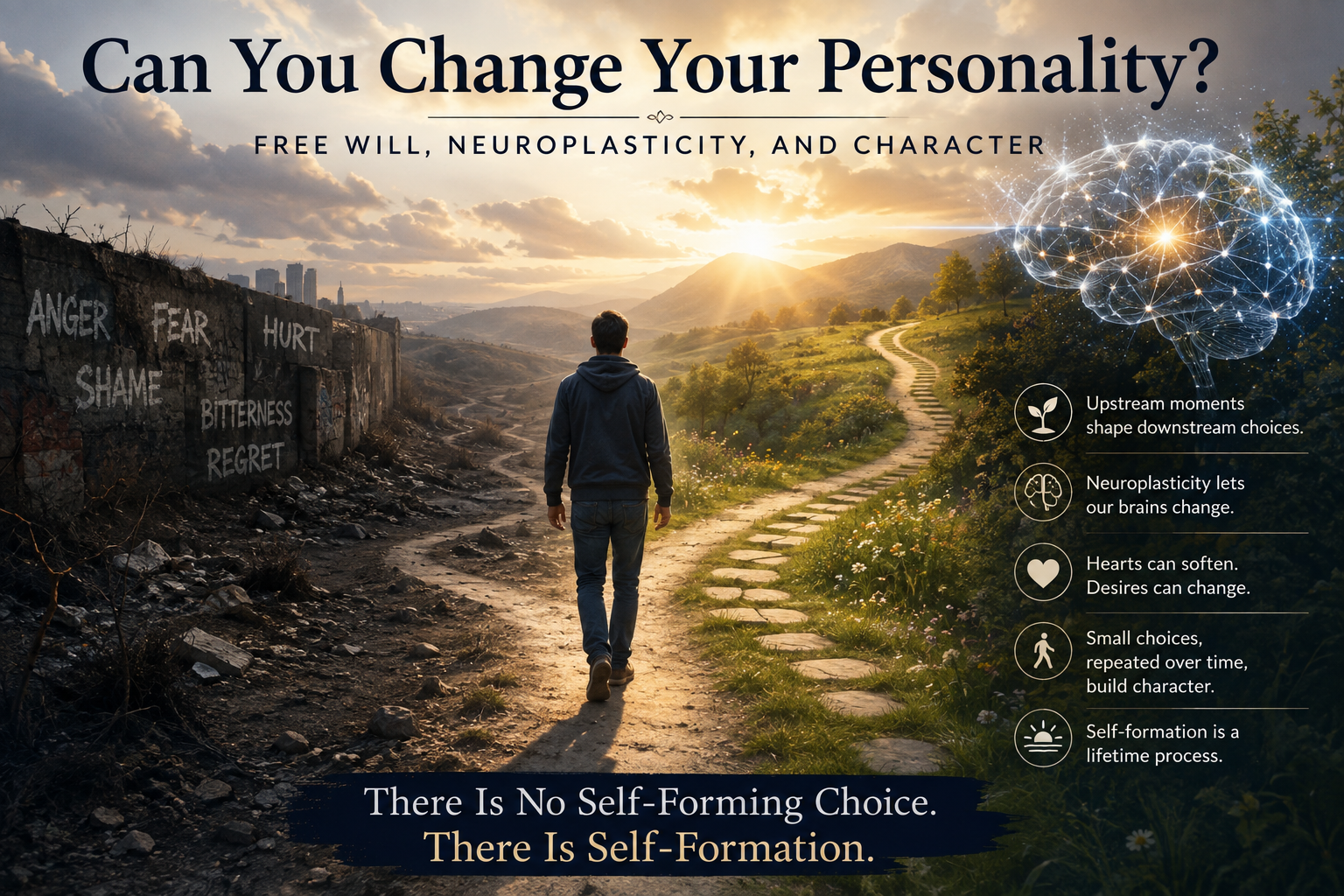
After publishing my second essay, I wanted to pressure-test its core arguments. Below is a cleaned-up and edited version of a substantial philosophical debate I had with Grok. These exchanges helped me refine my thinking.
Critic:
This essay is emotionally powerful. The examples of the condemned man, loveless vows, and Viktor Frankl in Auschwitz make a strong case that without free will, love, morality, and meaning collapse. However, I see significant philosophical problems.
Appeal to Consequences
You argue that if free will is an illusion, then life has no meaning — therefore free will must exist. This is a classic appeal to consequences. Just because a belief would make life unbearable doesn’t make it true.
JB:
I openly acknowledge this in the essay. I am not claiming empirical proof. I am saying that for our lives to have genuine purpose, love, and moral weight, free will must exist. If we have a loving Creator who made us for relationship, then this conclusion follows logically.
Critic:
Even granting your theological framework, the Eden account raises difficult questions. If God is all-powerful and loving, why set up a situation where one couple’s failure dooms billions to suffering?
JB:
The tree was necessary to allow genuine free choice and the real expression of love. Without the possibility of disobedience, love would be meaningless. The choice had to be real, and the consequences had to be real.
Critic:
But if God is omniscient, He knew in advance they would sin. Doesn’t that make Him responsible for the suffering that followed?
JB:
God is capable of knowing all futures, but He exercises that foreknowledge selectively. It’s like reading a mystery book — you have the ability to skip to the ending, but you choose not to because it would ruin the experience. God foresaw all possible outcomes with the tree in Eden and prepared for each, but He did not choose to fixate on their failure in a way that would undermine the genuine nature of their choice.
Critic:
Even if God chose not to “skip ahead,” He still created beings with the capacity to sin, placed the tree there, and allowed the serpent access. Doesn’t this still make Him responsible for the massive suffering that followed?
JB:
The issue was fundamentally about sovereignty. Satan raised two challenges: that humans could rule themselves better than God, and that humans are deterministic and would always choose immediate self-interest over loyalty to God. The second point was later tested and answered in the case of Job.
God is omnipotent, but He operates within the framework of laws and principles He has established for the universe. He will not violate His own standards of justice, love, and free moral agency. His options are therefore finite within that consistent framework. Allowing the test to play out was necessary to resolve the sovereignty issue fairly. He already had the solution prepared from the beginning (Genesis 3:15) and ultimately the ransom, so that His original purpose could still be fulfilled.
Critic:
So ultimately, your position relies on accepting God and a degree of mystery around how free will operates?
JB:
Yes. I believe the spark of consciousness is a God-given miracle built into creation. While the exact mechanism may remain partially mysterious to us, the practical reality is clear: protecting our upstream moments gives us real leverage to shape who we become.
This dialogue pushed me on several fronts and helped me clarify my position. I acknowledge that some aspects remain mysterious and that my argument depends on belief in a loving Creator. I’m not claiming to have proven free will in a laboratory sense. I am arguing that free will is necessary for life to have real meaning, love, and purpose — and that protecting the upstream moments where it operates is essential.
I welcome thoughtful feedback.