
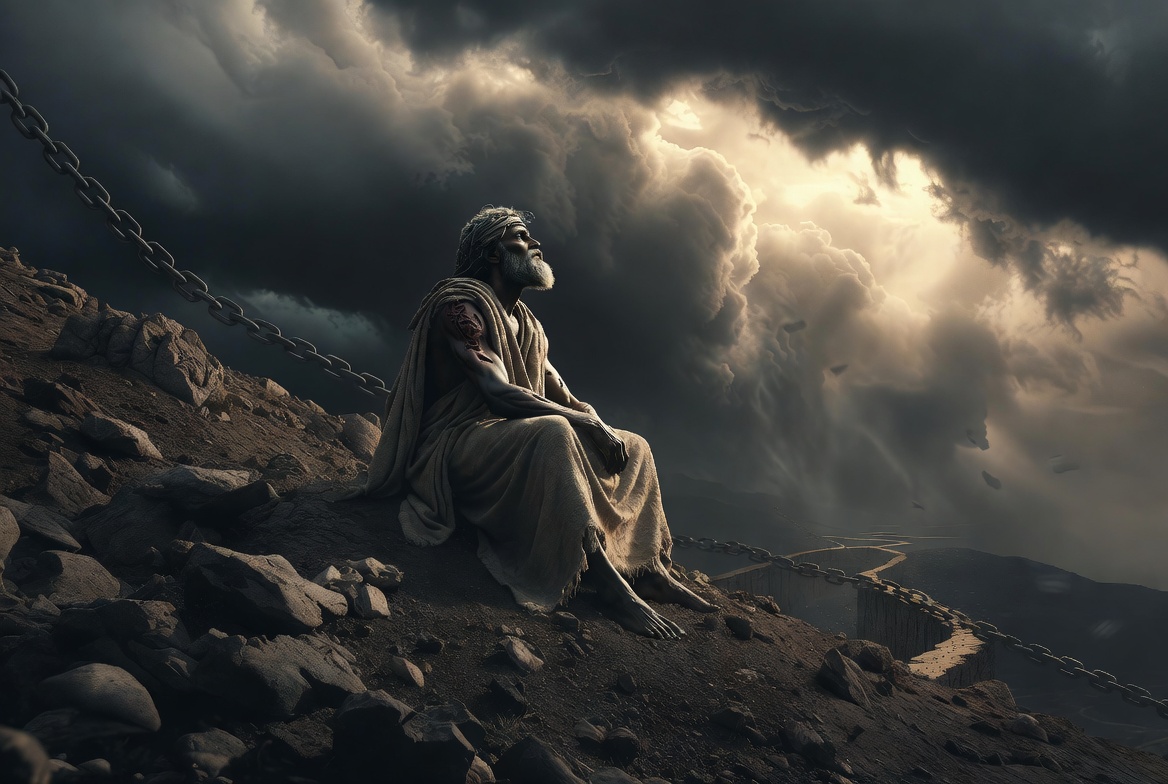
“Now the day came when the sons of the true God entered to take their station before Jehovah, and Satan also entered among them. (What the book of Job teaches about free will.)
“Then Jehovah said to Satan: ‘Where have you come from?’ Satan answered Jehovah: ‘From roving about on the earth and from walking about in it.’ And Jehovah said to Satan: ‘Have you taken note of my servant Job? There is no one like him on the earth. He is an upright man of integrity, fearing God and shunning what is bad.’
At that Satan answered Jehovah: ‘Is it for nothing that Job has feared God? Have you not put up a protective hedge around him and his house and everything he has? You have blessed the work of his hands, and his livestock has spread out in the land. But, for a change, stretch out your hand and strike everything he has, and he will surely curse you to your very face.’ Then Jehovah said to Satan: ‘Look! Everything that he has is in your hand. Only do not lay your hand on the man himself!’”
Job 1:6-12
What the book of Job teaches about free will
Satan made a wager. Satan told God that Job only fears Him because He blesses him. He then bet that if God took all that away, Job would curse him to his very face.
The wager was that man would always react deterministically in his own self-interest. What was at stake was the existence and wisdom of free will.
Read through the lens of modern philosophy, Satan’s argument sounds remarkably like hard determinism: Job’s righteous behavior can be explained by the conditions surrounding him. Change those conditions, Satan claimed, and Job’s behavior would change with them.
So the wager was on. God allowed Satan to do the following to Job, without his even being aware of the circumstances. Let’s see what the book of Job teaches about free will.
- He destroyed all of Job’s wealth and livestock through raiders and fire from heaven.
- Satan then killed all ten of Job’s 10 children in a single day when a house collapsed on them.
- He then afflicted Job with severe, painful sores from the soles of his feet to the top of his head.
Satan’s goal was to prove that Job’s righteousness was purely downstream — a deterministic reaction to favorable circumstances. Remove the blessings, he claimed, and the loyalty would disappear.
Satan’s challenge to Job’s free will
So, how did it turn out? What did Job say after all that calamity was brought on him for no reason?
“Until I die, I will not renounce my integrity! I will maintain my righteousness and never let it go;” — Job 27:5,6
Of course, Job didn’t know anything about what I call the Upstream Moment. But his life illustrates it beautifully. His integrity wasn’t created on the day his world collapsed. It had been formed over a lifetime. Through countless experiences, reflections, prayers, and choices, Job had gradually become the man who faced that test.
When the crisis came, his character was already there.
Job didn’t become Job on the day his world collapsed.
He did the exact opposite of what Satan predicted. Satan believed Job’s loyalty could be explained by the favorable conditions surrounding him: remove the blessings and the loyalty would disappear. Job proved Satan’s accusation false. His integrity was deeper than the circumstances Satan believed were producing it.
To be sure, Job could have caved. He could have succumbed and cursed God. He had true free will. Real love and loyalty require the real possibility of refusal.
Job’s story shows that such loyalty is possible.
Today, Satan has a new tactic. Our modern world presents a danger to the Upstream Moment: constant distraction, algorithms, notifications, entertainment, and noise. Whatever their source, these things can crowd out the quiet reflection in which character is formed.
Guard your Upstream Moments. Don’t allow your mind to become purely reactive.
Guard your Upstream Moments. Don’t let Satan program your brain.
Even in suffering, free will can win. Job’s story shows that upstream character formation can produce loyalty that survives the worst downstream trials.
A hard determinist might object that Job’s response proves nothing. Perhaps his character had become so firmly established that, by the time disaster struck, he was effectively determined to remain faithful.
But that is exactly my point.
The real question isn’t simply why Job remained faithful on the worst day of his life. The question is how Job became the kind of man who would remain faithful on the worst day of his life.
His character didn’t appear that morning.
It had been forming for years.
The hard determinist will simply push the causal chain farther upstream and argue that every experience, thought, and decision that formed Job’s character was itself determined. And that is where our disagreement really lies.
I believe Job was more than the product of what happened to him. Throughout his life, within all the circumstances he did not choose, Job possessed something else: genuine agency.
God created Job. Life shaped Job. But Job also participated in becoming Job.
So when the crisis finally arrived, his established character may indeed have strongly constrained what he would do next.
His mind was already made up.
That doesn’t eliminate the role of free will.
It tells us where to look for it.
Job integrity and free will
Personally, I have faced many trials. For the past 25 years I have taken antipsychotics for schizoaffective disorder, bipolar type. The medication has taken a heavy toll, leaving me with severe drug-induced Parkinsonism: constant dyskinesia, akathisia, and shaking. I no longer know what a quiet moment feels like.
Yet I choose to be happy. I trained my mind over many years so that when adversity came, I would remain faithful and joyful. I still choose to trust God.
Guard your Upstream Moments. They are where real loyalty is formed.
See this article for a full discussion of how Job kept his integrity–>
For more info on what the upstream moment is ->