Can you change your personality?
Research suggests that personality is not completely fixed. People can and do change over time, and intentional interventions can produce measurable changes in personality traits.
But that doesn’t mean you can simply wake up one morning and decide to become a different person.
Real personality change appears to be much more gradual. It happens through repeated patterns of thought, behavior, experience, and conscious effort. The person you are today influences the choices you make, but those choices also participate in shaping the person you will be tomorrow.
That raises a much deeper question.
If we can participate in changing our personality, what does that tell us about free will?
This question takes us directly into one of the most difficult arguments against genuine free will.
Galen Strawson’s Argument Against Free Will
Philosopher Galen Strawson has presented a deceptively simple argument against what he calls ultimate moral responsibility.
We make choices based on who we are—our character, desires, values, experiences, and dispositions. But if I am responsible for a choice because of the kind of person I am, then it seems I must also be responsible for becoming that kind of person.
Suppose I decide that I want to become a better person.
Why?
Presumably something about the person I already am caused me to want to become better. Perhaps I value kindness. Perhaps I have a strong conscience. Perhaps I regret things I have done.
But where did those qualities come from?
If I deliberately developed them earlier, then we can ask why the earlier version of me wanted to develop them.
Keep going backward and eventually we encounter a self that I did not create.
Strawson’s conclusion is that ultimate moral responsibility is impossible. To be ultimately responsible for what we are, we would ultimately have to be responsible for creating ourselves.
It’s a formidable argument.
But I think it may begin with the wrong picture of how people actually change.
We Don’t Start at Zero
Nobody begins life as a blank slate.
Our personalities begin developing before we are capable of making conscious choices. Genetics matters. Prenatal development matters. Temperament matters. Our brains differ. Then we are born into environments we didn’t choose, to parents we didn’t choose, under circumstances we didn’t choose.
Some children appear naturally cautious. Others are adventurous. Some are highly empathetic. Others are less sensitive to the feelings of those around them. Some are calm. Others are impulsive.
Whatever free will is, it doesn’t begin with a neutral person standing between two equally weighted possibilities.
We are given a starting point.
And we cannot reasonably be held morally responsible for that starting point.
But where we start does not necessarily determine where we will end up.
Can People Really Change Their Personality?
Personality was once commonly thought to become largely fixed by adulthood. Research now paints a more complicated picture.
Personality traits show considerable stability, but they can also change throughout life. A 2024 systematic review of 30 longitudinal studies found that simply wanting to change one’s personality was only weakly associated with actual change. Interventions designed to facilitate personality change, however, produced measurable changes in the desired direction.
In one large randomized controlled trial, 1,523 participants used a three-month digital intervention designed to help them change selected personality traits. Participants receiving the intervention changed more than controls, and the changes were still detectable three months after the intervention ended.
This distinction matters.
Wanting to change isn’t the same thing as changing.
You don’t become patient simply because you decide that patience would be a desirable quality. You don’t become compassionate because you conclude intellectually that compassion is good.
Change requires a process.
And that process may involve one of the most remarkable characteristics of the human brain: neuroplasticity.
Neuroplasticity and Personality Change
The brain changes in response to experience.
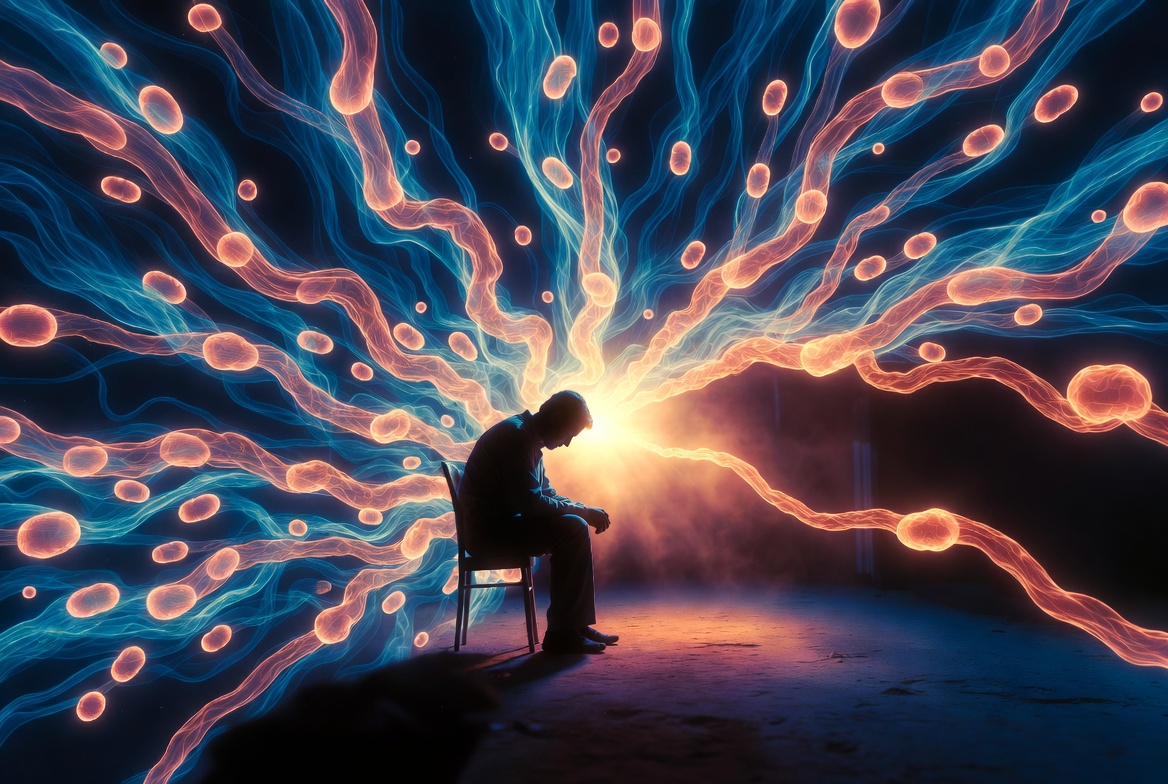
Neural pathways that are repeatedly activated can become easier to activate again. Learning, attention, behavior, and repeated experience can alter the physical and functional organization of the brain.
This doesn’t mean neuroscience has discovered a simple “personality pathway” that we can consciously rewire at will.
Personality is vastly more complicated than that.
But neuroplasticity gives us a biological mechanism through which repeated patterns of thought and behavior can influence future patterns of thought and behavior.
Something practiced repeatedly can gradually become easier.
Eventually it can become habitual.
And eventually what began as effort can start looking like character.
This is where the question of free will becomes interesting.
Nobody Wakes Up and Decides to Become Good
Imagine a hardened criminal.
He grew up surrounded by violence. As a child, violence was normalized. Perhaps cruelty was rewarded and vulnerability punished. Over many years, his experiences and his own behavior reinforced patterns of aggression.
Eventually violence becomes part of his character.
Then imagine that over the course of many years this man changes.
He becomes gentle. Compassionate. Honest. Perhaps even extraordinarily kind.
How did that happen?
It is unlikely that he woke up one morning and announced:
I’ve decided I’m going to stop being a bad person and become a good person.
Real human change rarely works that way.
Perhaps someone showed him kindness he didn’t expect.
Perhaps something he did began bothering him.
Perhaps he encountered an idea that stayed with him.
Perhaps he started reading the Bible.
Perhaps he saw what his behavior was doing to his children.
Perhaps one evening he allowed himself to think about something he had spent years refusing to think about.
Then another small moment came.
And another.
He might have resisted some of them. He might have gone backward. He might have changed in one area while remaining exactly the same in another.
But gradually something happened.
The Bible uses an interesting expression for this process. It speaks of “putting on the new personality.”
A new personality isn’t put on in an afternoon.
It is built.
The Heart Changes Before the Person Does
The Bible also repeatedly talks about the condition of the heart.
The Israelites were sometimes described as hardhearted. Jesus illustrated people receiving the same message differently by comparing them to different kinds of soil. Some soil was rocky. Other soil was fine.
What is a “heart condition”?
I don’t think it simply means personality.
It seems to describe something deeper about our inner orientation—what we value, what moves us, what we resist, what bothers our conscience, what we find attractive or repulsive, and how receptive we are to what is placed before us.
And heart condition can change.
A person can repeatedly ignore his conscience until something that once bothered him barely registers.
But the reverse can also happen.
A person can begin contemplating things he previously dismissed. He can deliberately consider another person’s feelings. He can pray. He can reflect. He can reconsider an assumption. He can interrupt one line of thought and pursue another.
None of these moments transforms him.
But there can be thousands of them.
Millions.
These are what I call upstream moments.
What Is an Upstream Moment?
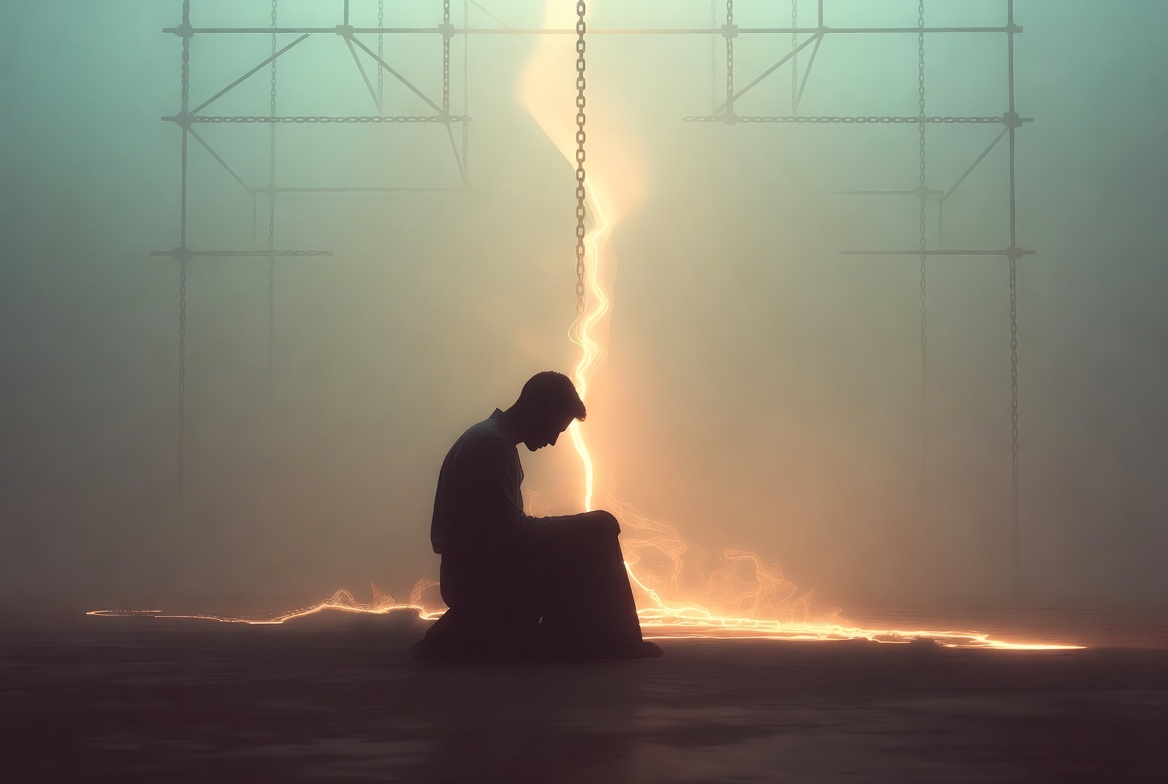
We tend to think of free will as something exercised at the moment of decision.
The temptation appears.
The crisis arrives.
Two alternatives stand before us.
We choose.
But what if we’re looking for free will too late?
By the time a powerful temptation or moral crisis arrives, years of previous experience may already have shaped the neural pathways competing for control. One response may exert far more pressure than another.
The dramatic decision we experience consciously may therefore be considerably more “downstream” than we realize.
An upstream moment occurs earlier.
It can be an ordinary moment of reflection when immediate neural pressure is relatively low.
A thought entertained.
A thought rejected.
A few seconds of reflection.
A prayer.
An act of kindness.
A rationalization.
A moment of resentment replayed again.
A moment of resentment deliberately released.
None seems particularly important.
But they accumulate.
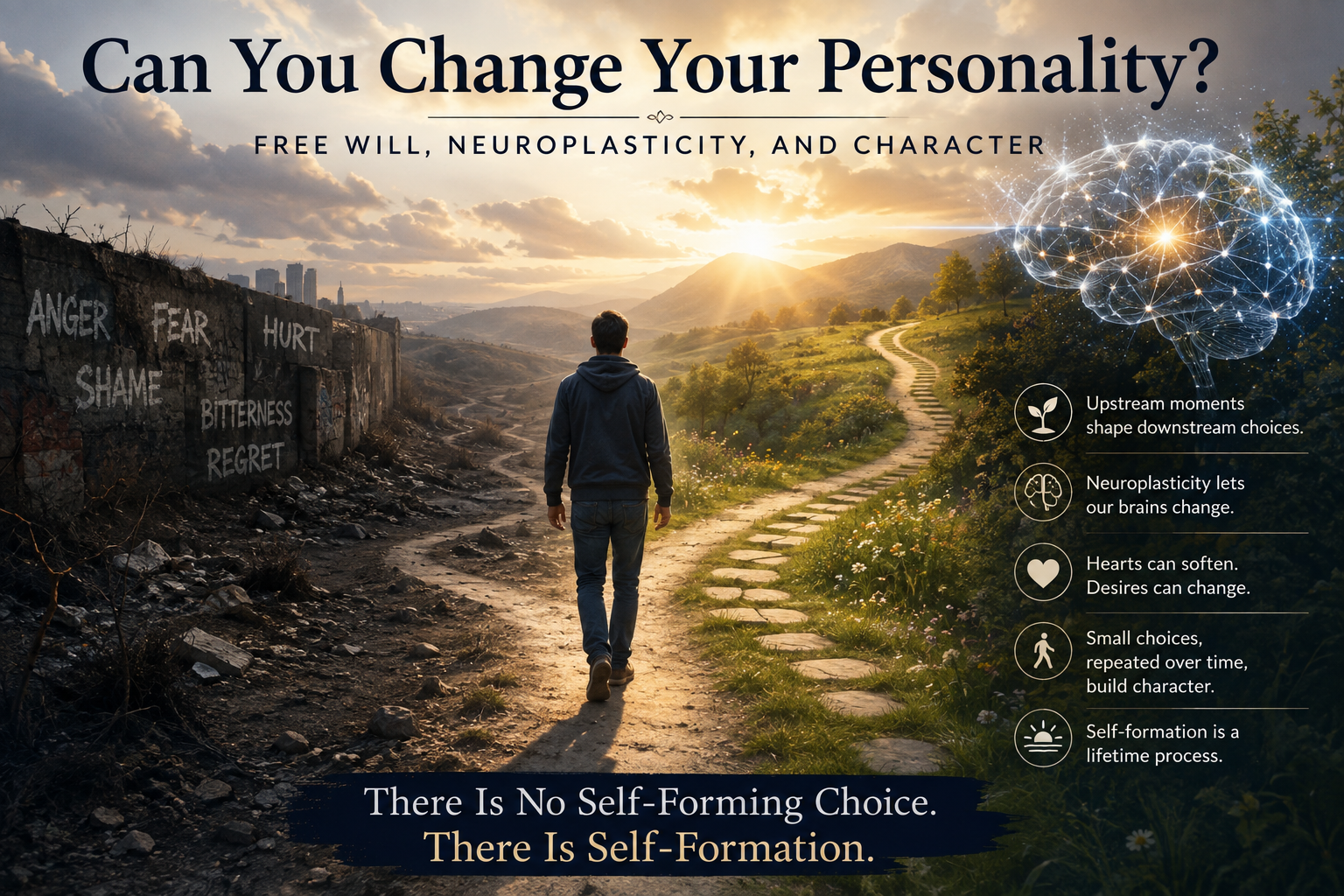
There Is No Self-Forming Choice. There Is Self-Formation.
Philosopher Robert Kane has proposed the idea of “self-forming actions”—particularly significant choices made under certain conditions of internal conflict that contribute to the character we subsequently possess.
I think something almost opposite may be happening.
The dramatic crisis may actually be where our freedom is most constrained.
If an established neural pathway has been reinforced for years, the moment when it is powerfully activated may not be the moment of greatest freedom.
The greater opportunity for agency may have existed long before the crisis.
So rather than a few extraordinary choices forming our character, perhaps character emerges through countless ordinary ones.
There is no self-forming choice. There is self-formation.
It happens incrementally.
And neuroplasticity provides a way for those increments to accumulate physically.
One small choice doesn’t make someone compassionate.
But repeatedly directing attention toward the suffering of others, repeatedly choosing compassionate behavior, repeatedly contemplating the value of other people, and repeatedly resisting selfish impulses can gradually affect what comes naturally.
Eventually the person doesn’t merely act compassionately.
He may actually become compassionate.
The Desire to Change Is Part of the Change
This brings us back to Strawson.
Suppose someone says:
“I decided I wanted to become a good person.”
Strawson can ask:
“Why did you want to become good?”
That’s difficult to answer if the desire to become good is treated as the starting point.
But I don’t think it is the starting point.
The desire to change can itself be a product of changing.
The hardened criminal may initially have almost no desire to become a different person.
But something happens to him.
He responds.
Something else happens.
He thinks about it.
He makes a tiny choice.
That affects the person who encounters the next experience.
Perhaps his heart softens almost imperceptibly.
Now the next moral consideration means slightly more to him than it would have before.
He responds again.
Over years, a feedback process develops:
Experience influences choice.
Choice influences the person.
The changed person experiences the next event differently.
That creates another opportunity for choice.
Eventually the man may sincerely say:
“I don’t want to be that person anymore.”
But that desire didn’t suddenly appear from nowhere.
It has a history.
But Why Did He Make the First Different Choice?
Strawson can still push the argument further.
Take one tiny upstream moment.
Why did the man respond differently this time?
Perhaps someone showed him kindness. Perhaps he remembered his mother’s words. Perhaps he felt remorse. Perhaps he was tired of what his life had become.
Fine.
But why did those things move him?
At some point, I think we reach the mystery at the center of free will.
There may be no definitive why.
That doesn’t mean there were no reasons.
A person can ponder something. He can evaluate competing considerations. His genetics, disposition, environment, previous experiences, existing character, heart condition, and current neural state can all influence the decision.
But influence is not necessarily determination.
At some point the person chooses.
If we then demand another sufficient cause that made him make that choice, we have defined genuine agency out of existence before we begin looking for it.
If something else fully determined the choice, then the person wasn’t the ultimate source of that choice.
But if the choice was merely random, we haven’t found free will either.
I am proposing a third possibility.
The agent chooses.
Does Neuroplasticity Prove Free Will?
No.
That’s an important distinction.
Neuroplasticity can help explain how repeated thought, experience, and behavior change the brain.
It cannot tell us whether a conscious person genuinely originated any of those thoughts or choices.
A determinist can accept neuroplasticity completely. He can simply argue that whatever caused the brain to change was itself determined by what came before it.
So neuroscience alone doesn’t get us to free will.
The Upstream Moment theory requires another premise:
Genuine agency exists.
And that premise takes us beyond neuroscience into philosophy—and, in my case, theology.
Agency May Be Fundamental
This is where my view ultimately rests on belief in God.
I don’t believe human beings are merely physical machines whose every thought and action is completely determined by the state of the machine one instant earlier.
I believe God created conscious beings capable of genuine agency.
How does that work?
I don’t know.
I don’t know what consciousness ultimately is either.
We can describe brain activity associated with conscious experience in extraordinary detail without explaining why there is a subjective experience at all.
Free agency may present us with a similar mystery.
If God created beings capable of originating genuine choices, the mechanism by which consciousness introduces that agency into the physical world may simply be beyond our present ability to understand.
From my perspective, that capacity is a miracle.
That isn’t intended as a scientific explanation. It is a metaphysical and theological claim.
Neuroscience can tell us a great deal about the forces acting upon a decision. It can tell us about learning, reinforcement, neural pathways, and neuroplasticity.
It cannot presently tell us whether those physical processes exhaust everything occurring when a conscious person makes a choice.
I don’t believe they do.
We Don’t Create Ourselves
So I agree with Strawson about something important.
We don’t create ourselves.
I didn’t choose my genetics.
I didn’t choose my initial disposition.
I didn’t choose the brain with which I entered the world.
I didn’t choose my childhood.
I didn’t choose countless things that happened to me.
I therefore cannot reasonably be morally responsible for any of those things.
But it doesn’t follow that I have contributed nothing to the person I have become.
That is where I part company with Strawson.
I didn’t create the person. I participated in creating the character.
And that participation didn’t happen in one great act of self-creation.
It happened through a lifetime.
Circumstances acted upon me. Other people acted upon me. My biology acted upon me. Chance events changed me.
And threaded through all of it were countless small moments in which I consciously responded to what was happening.
Agency wasn’t an event.
Agency was a thread.
Personality, Character, and Moral Responsibility
This has profound implications for moral responsibility.
Two people can commit the same act without necessarily carrying precisely the same degree of responsibility.
One may have inherited enormous disadvantages the other never faced. One may have been conditioned from childhood toward behavior the other was conditioned to reject.
Those things matter.
But so does what each person did, over time, with what he was given.
We cannot calculate that perfectly.
We see someone’s behavior. We might know portions of his history. But we cannot know every influence that formed him, every pressure operating upon him, every opportunity he had to change, or every upstream moment in which genuine agency may have been exercised.
God can.
Perhaps that is one reason ultimate judgment belongs to him.
Perfect moral judgment would require perfect knowledge of both causation and agency—everything that happened to a person and everything that person genuinely contributed in response.
Can You Change Who You Are?
So, can you change your personality?
To some extent, the evidence says yes.
But the deeper answer is more interesting than that.
We begin life with dispositions we did not choose. Then life happens to us.
Our environment affects us.
Other people affect us.
Our experiences affect us.
Our previous behavior affects us.
Our brains change.
And through millions of seemingly insignificant upstream moments, our hearts can slowly change as well. Desires change. Values change. Neural pathways change. Character emerges.
Eventually we can become people capable of responses that an earlier version of ourselves might never have imagined.
For better or worse.
We don’t create ourselves from nothing.
But neither, I believe, are we merely spectators watching ourselves become whatever prior causes dictate.
If God has given us genuine agency, then throughout our lives we participate in the process.
And that means something extraordinarily hopeful:
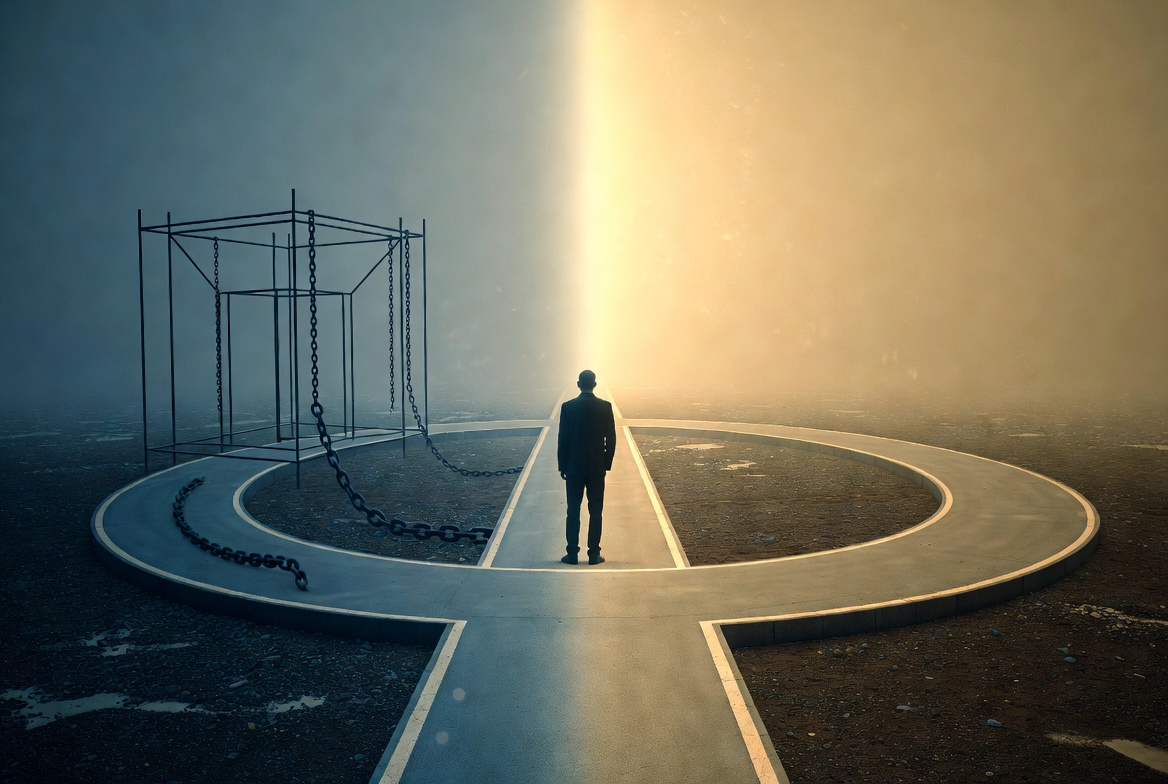
Where you start does not determine where you will end up.
Read more about the upstream moment–>