
There are those who say free will is compatible with determinism. They want to have their cake and eat it too. Free will compatibilism explained.
To review, Determinism is the view that every event, including every human thought, decision, and action, is the inevitable result of an unbroken causal chain. This chain begins with factors outside our control (genetics, prenatal conditions, early childhood experiences) and flows through brain chemistry, hormones, past habits, current environment, and immediate circumstances, leaving no room for genuine free will or the ability to have done otherwise.
Problems with free will compatibilism
Compatibilists say reality is deterministic; every action we take is the result of a prior state or action. Yet, somehow they try to wedge in moral responsibility and freedom of choice into the sequence. There are various ways that they try to reconcile the two, which we will go over. But ultimately, they are just word games and redefining what free will means (to basically be not free).
Classical Compatibilism (Hobbes, Hume, Mill, G.E. Moore)
Free will compatibilism explained.
- Core Idea: Freedom is the ability to act according to one’s own desires and will without external coercion or impediments.
- How it reconciles: Determinism does not prevent you from doing what you want. Even if your desires are determined, acting on them is still “free” in the relevant sense.
- Key Tool: The conditional analysis of “could have done otherwise.”
- “I could have done otherwise” means: “I would have done otherwise if I had wanted to (or if the circumstances had been different).”
- Example: A person in prison is not free because there are external impediments. A person who is not imprisoned but acts on their (determined) desires is free.
Basically, whatever happens, after the fact, you can say I could have done different if I had wanted to. Where did the want come from. A determinist will say, the brain fired according to preset pathways resulting in the want. You couldn’t have wanted anything different.
It is like saying, I could have won that chess match if I had wanted to. It is unfalsifiable. The circumstances fall under determinism.
Hierarchical (or Mesh) Compatibilism (Harry Frankfurt)
Free will compatibilism explained.
- Core Idea: Free will depends on the alignment between different levels of desire.
- How it reconciles: You are free when your first-order desires (what you want to do) align with your second-order desires (what you want to want).
- Key Distinction:Willing addict: Wants the drug and wants to want the drug → free (even if addiction is determined).Unwilling addict: Wants the drug but does not want to want it → not free.
- Freedom is about identification with one’s own desires, not about escaping causation.
This one doesn’t even make sense. I am free if I want to want to do what I do?
Where does it end? The regression could go on infinitely, e.g., third-order desires, fourth-order, etc.
The counterargument to this problem usually says the regress stops when a person reaches a desire they wholeheartedly identify with — a point where they no longer have conflicting higher-order desires.
So what is the desire they wholeheartedly identify with? Isn’t that a function of brain chemistry and neural pathways that already exist? It is still deterministic. The causal chain is unbroken and still rules.
Reasons-Responsive Compatibilism (John Martin Fischer, Gary Watson, Susan Wolf)
Free will compatibilism explained.
- Core Idea: Free actions are those produced by mechanisms that are responsive to reasons.
- How it reconciles: You have “guidance control” if your decision-making process would have produced a different action had there been different (good) reasons. You don’t need the ability to do otherwise in the actual world — only counterfactual sensitivity to reasons.
- This focuses on the actual sequence of causation rather than requiring alternative possibilities.
Basically, this is saying that if there had been different circumstances, you would have made a different decision. They try to confuse this with wordplay, saying the focus is on the actual causal sequence that produced the action, not on whether other sequences were possible.
As an example:
You decide to keep $20 you found on the ground.
A reasons-responsive compatibilist would say you are responsible if:
Had there been good reasons not to keep it (e.g., you knew it belonged to a poor person, or there was a clear owner), your reasoning process would have led you to return it.
Even if determinism made you keep it in the actual situation, your mechanism was still “reasons-responsive.”
But isn’t that still just saying that if it were a different circumstance, i.e., you knew who it belonged to, you would have responded differently because of that reason?
If the causal sequence was that you knew who the money belonged to before finding it, you would have reasoned differently. Again, a different set of circumstances resulting in a different decision.
Circumstances are deterministic.
Free will compatibilism explained.
Semi-Compatibilism (John Martin Fischer)
Free will compatibilism explained.
- Core Idea: Moral responsibility is compatible with determinism, even if (strong) free will is not.
- How it reconciles: Fischer is agnostic about whether determinism rules out free will, but argues that responsibility does not require the ability to do otherwise. What matters is that the person’s action flows from their own reasons-responsive mechanism.
- This separates the free will debate from the responsibility debate.
Basically, we gave up on reconciling free will with this. It separates moral responsibility from free will, conceding that with regard to free will, it is deterministic, meaning no free will, but somehow you are still morally responsible for your actions.
This seems like an arbitrary separation to satisfy morality.
If you had no choice but to kill someone, how can you be morally responsible? The two cannot be separated.
It falls back on the reasons-responsive mechanism. But has all the same flaws.
Strawsonian Compatibilism (P.F. Strawson)
- Core Idea: Moral responsibility arises from our natural reactive attitudes (resentment, gratitude, indignation, forgiveness) in interpersonal relationships.
- How it reconciles: These attitudes are part of normal human social life and do not depend on metaphysical questions about determinism or alternative possibilities. As long as we participate in these practices, we can hold people responsible.
This one gave up on the debate entirely. It just changed the subject.
If determinism is true and no one could have done otherwise, our reactive attitudes (like resentment) may still be natural, but they might be unfair or based on an illusion.
Key Example
If someone steps on your foot accidentally, you might feel mild annoyance but quickly forgive them. If they do it deliberately and maliciously, you feel resentment. These reactions are natural and don’t require you to first solve the free will problem. The practice of holding people responsible is built into human life.
Basically, ignores the free will of the person who did the stepping and says they are morally responsible because they did it on purpose. That purposfulness is easily explained by determinism; no free will involved.
This is like saying the resulting fire was the cause of the explosion. It is backward. Instead of starting with the actual cause (the explosion / genuine free will), Strawsonian compatibilism starts with the effect (our natural human practices of resentment, praise, blame, etc.) and uses that to define responsibility.
Problems with free will compatibilism
In the end, compatibilism — whether classical, hierarchical, reasons-responsive, semi-, or Strawsonian — often feels like an unsatisfying compromise. It tries to keep the word “free will” while redefining it in ways that no longer capture genuine agency, or it shifts the focus away from the hard metaphysical questions altogether. Whether through conditional analysis, hierarchical desires, reasons-responsiveness, or reactive attitudes, these approaches ultimately accept the full causal chain and then find clever ways to still call the result “free.”
That said, compatibilists do get one thing right: they recognize that previously formed character plays a significant role in the decisions we make. In that, I wholeheartedly agree. However, I believe the Upstream Moment offers a better and more coherent path.
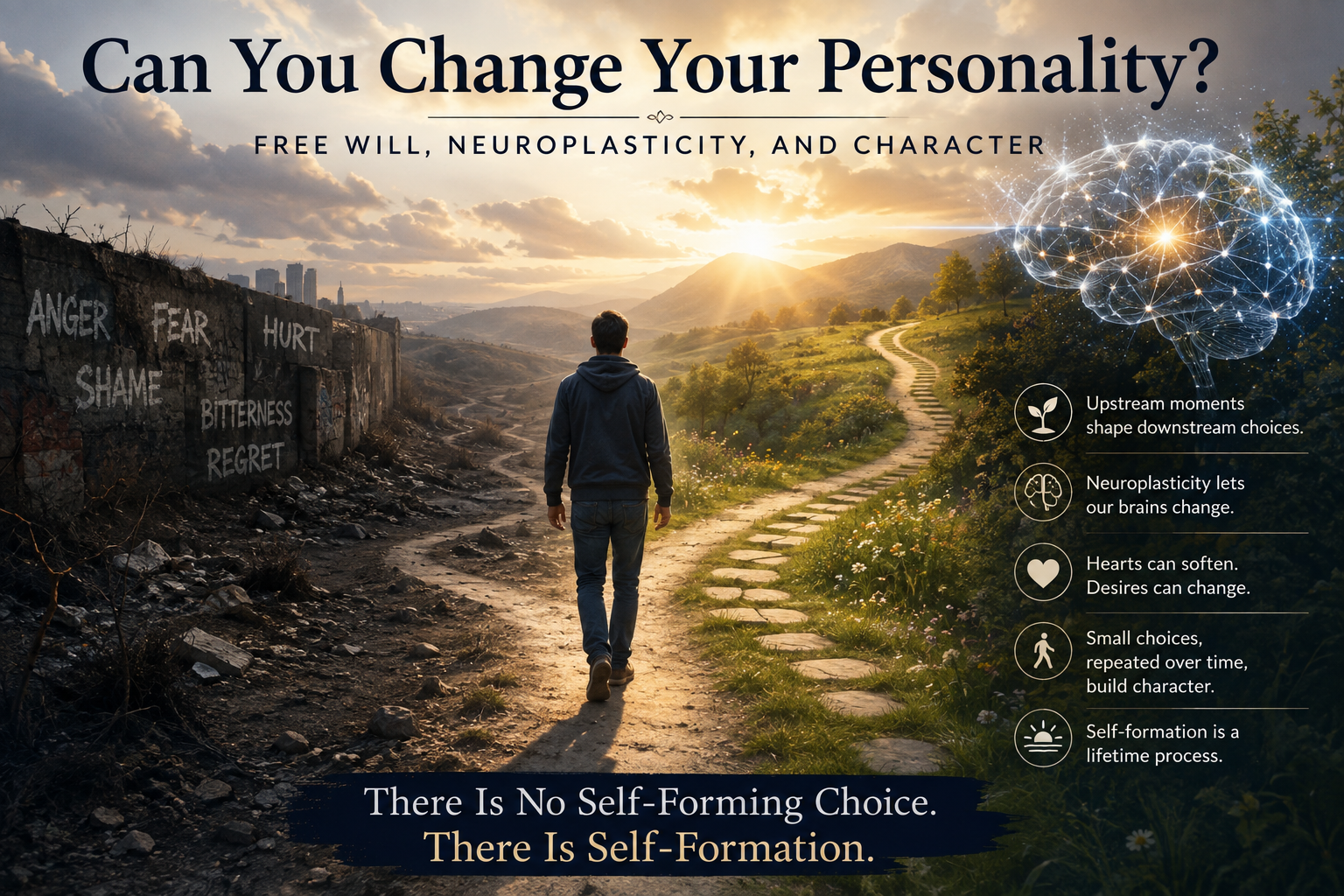
It does not deny the reality and power of the causal chain. Nor does it require magical gaps or redefinitions of freedom. Instead, it locates genuine (though limited) agency in the quiet, low-pressure spaces of reflection before the strong impulse or decision arises. In these moments, when neural pressures are relatively balanced, we can consciously choose which thoughts to pursue and which neural pathways to strengthen. Through repeated upstream choices and neuroplasticity, we gradually shape our character and influence future downstream actions.
Free will, then, does not break the causal chain or exist magically outside it. It becomes part of the chain — upstream — where small, deliberate decisions compound over time. This avoids the word games of compatibilism while still preserving real moral responsibility, love, and meaning.
This is why we must protect our quiet moments of reflection. They are where character is formed, addictions are made or broken, and real agency is exercised. The Upstream Moment is not a perfect or absolute freedom, but it is real freedom — the kind that makes us truly human.
The upstream moment explained ->
Compatibilism explained in detail ->