When I began thinking seriously about free will, I started from a premise surprisingly close to Robert Sapolsky’s.
I believed the physical universe was deterministic.
What happens in one instant follows from what happened in the instant before it. Our brains are physical objects within that causal stream. Genetics, prenatal development, childhood, hormones, environment, experience, and the previous state of the brain all contribute to what happens next.
That presented me with a problem.
I also believed in God. And because I believed in God, I believed human beings must possess genuine agency. Love, moral responsibility, and our relationship with God would mean something very different if every human action were merely the inevitable output of previous physical causes.
So where could free will possibly enter a deterministic causal stream?
That question eventually led me to what I call the Upstream Moment.
Only later did I encounter Sapolsky’s argument in detail and discover something surprising.
Of all the positions on free will I have encountered, his description of human causation may be the one closest to my own.
We disagree at one tiny—but enormously important—point.
Sapolsky believes the contribution of the conscious agent is zero.
I don’t.
Where Sapolsky and I Agree
In Determined, Sapolsky argues that there is no free will.
But he also makes a more modest point: we have far less control over ourselves than we ordinarily imagine.
On that point, he doesn’t need to convince me.
I already agree with him.
Every decision we make has a history.
Our genetics affect our brains.
Our prenatal environment affects our brains.
Our childhood affects our brains.
Culture, hormones, trauma, education, relationships, previous experiences, and everything that has happened to us contribute to the state of the brain at any particular moment.
Then something happens.
Our neurons fire.
We act.
Where, Sapolsky asks, is the free will?
Consider a man who murders someone in a jealous rage.
We normally say:
“He chose to do it.”
Sapolsky asks us to look deeper.
What was happening in his brain seconds before the murder?
What happened five minutes earlier?
Did he sleep the previous night?
What were his hormone levels?
What happened during his childhood?
What kind of environment did he grow up in?
What genes did he inherit?
What happened during prenatal development?
The farther upstream we travel, the more causes we discover that the man never chose.
He didn’t choose his genes.
He didn’t choose his prenatal environment.
He didn’t choose his parents.
He didn’t choose his childhood brain development.
He didn’t choose many of the experiences that subsequently shaped his brain.
Simply saying, “But he chose to do it,” doesn’t make all of that disappear.
Sapolsky is right about that.
We Don’t Start at Zero
Nobody begins life as a blank slate waiting to exercise free will.
Before anything resembling moral agency develops, enormous amounts of development have already occurred.
We arrive with dispositions we didn’t choose.
Some children seem naturally calm.
Others are impulsive.
Some appear unusually empathetic.
Others struggle with empathy.
Then environment begins shaping us.
One child grows up surrounded by affection and stability.
Another grows up surrounded by violence and fear.
Neither chose his starting point.
So I don’t believe every human being begins with an identical amount of freedom and is then equally responsible for everything that follows.
Our starting points matter.
Our biology matters.
What happens to us matters.
I think we dramatically overestimate how free we are.
But there is an enormous difference between saying our freedom is limited and saying it is zero.
That is where Sapolsky and I eventually part company.
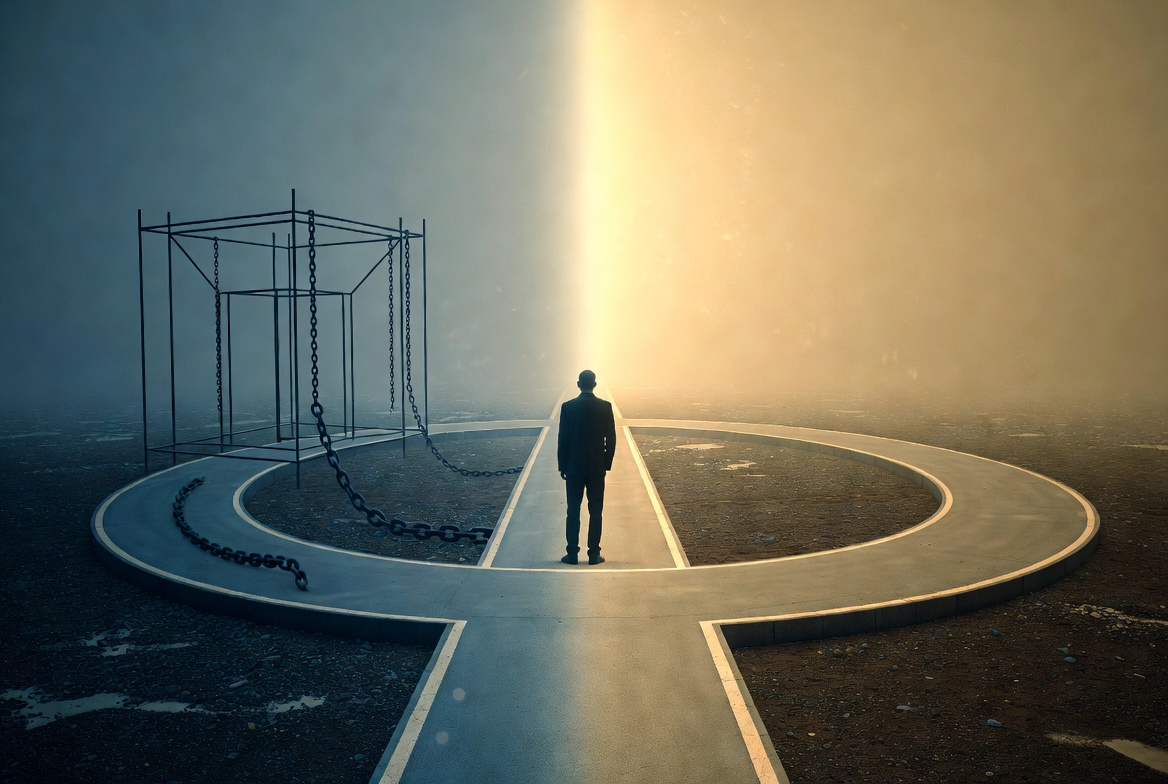
The Upstream Moment
We normally look for free will at dramatic moments.
A recovering addict experiences an overwhelming craving.
An angry person is insulted.
A married person encounters an opportunity to be unfaithful.
We imagine two possibilities appearing and free will stepping in to select one.
I increasingly doubt that these are the moments when our greatest freedom exists.
By then, years of experience, repetition, reinforcement, and habit may have created powerful behavioral tendencies. The immediate decision may be far more constrained than we realize.
I believe the more important opportunities for agency often occur earlier.
I call these Upstream Moments.
They are usually unimpressive.
A thought appears.
Do I entertain it?
Do I redirect my attention?
Do I replay the resentment?
Do I consider the other person’s perspective?
Do I indulge the fantasy?
Do I dismiss it?
Do I pray about it?
Do I rationalize what I’m considering?
Do I stop and think?
One such decision may make almost no noticeable difference.
But there can be thousands or millions of them over a lifetime.
Repeated experiences, thoughts, and behaviors can contribute to changes in the brain through neuroplasticity.
What we repeatedly do today can therefore become part of the physical conditions influencing what becomes easier to do tomorrow.
And eventually something we call character emerges.
But Sapolsky Can Follow Me Upstream
None of this defeats Sapolsky’s argument.
Suppose I have a quiet moment and reject a destructive thought.
Sapolsky can ask:
Why?
Perhaps my parents taught me certain values.
Perhaps I remembered something I had read.
Perhaps previous experience taught me where the thought would lead.
Perhaps I was rested and therefore had greater self-control.
Perhaps my existing brain structure made one response more likely than another.
Keep asking why and we can construct another causal chain.
Neuroplasticity doesn’t solve the problem either.
A determinist can accept neuroplasticity completely.
Yes, today’s behavior affects tomorrow’s brain.
But what caused today’s behavior?
Push the question upstream again.
Sapolsky can follow us all the way.
That’s why the Upstream Moment is not proof that free will exists.
It answers a different question.
If genuine agency exists, where might it have the greatest opportunity to operate?
My answer is: probably not when neural pressure is greatest.
Look upstream.
Where Sapolsky and I Part Company
Eventually we reach a quiet moment in which a person considers two possibilities.
Everything that has happened before that moment matters.
His genetics matter.
His childhood matters.
His current brain state matters.
His environment matters.
His existing character matters.
His previous choices matter.
The strength of his existing neural pathways matters.
All of it matters.
All of it exerts influence.
Sapolsky and I can travel together this far.
Then we reach the point where something happens.
A choice is made.
Sapolsky says that choice is completely accounted for by everything that preceded it.
The contribution of a genuinely choosing conscious agent is:
zero.
That is where I stop.
I don’t believe it is zero.
Much Less Is Not None
I don’t need to believe that human beings possess unlimited free will.
I don’t.
I don’t even need to believe that agency contributes very much to any individual decision.
Perhaps sometimes its contribution is minuscule.
Perhaps existing biology and circumstances exert enormous pressure toward one response.
Perhaps there are situations in which effective freedom is almost completely overwhelmed.
This is where I find myself in remarkable agreement with Sapolsky. We should take these forces far more seriously than we usually do.
But almost zero and zero are not the same thing.
If the contribution of the conscious agent is exactly zero, then everything I do is entirely the product of what happened before me.
I am where the causal chain happens.
I am not genuinely one of its authors.
But if the contribution of the agent is anything greater than zero, something fundamentally different has entered the picture.
Something comes from me.
It may be tiny.
But tiny is enough.
Injecting Agency Into the Causal Stream
This is actually the problem that led me to the Upstream Moment in the first place.
I already believed in a deterministic physical causal stream.
One physical state produces the next. That state becomes the cause of what follows, which becomes the cause of what follows after that.
But I also believed God gave human beings genuine agency.
So my question became:
Where can agency enter the stream?
I wasn’t looking for a way to eliminate causation.
I was looking for a place where the conscious agent could become one of the causes.
That distinction is important.
I am not proposing a conscious self floating above biology, untouched by genetics, experience, brain chemistry, or environment.
All of those things remain in the equation.
What I am proposing is that they may not be the entire equation.
The previous physical state may exert enormous influence over what happens next without completely exhausting the causal explanation.
At certain moments, the agent may contribute something of its own.
The causal stream continues—but now the agent has participated in determining where it goes.
Tiny Choices Can Accumulate
This is where the Upstream Moment becomes important.
Suppose the contribution of genuine agency to one quiet decision is extremely small.
That choice nevertheless becomes an experience.
That experience becomes part of the history of the brain.
And that changed history affects the circumstances under which the next decision occurs.
So the process becomes recursive:
history + agency → choice → experience → changed history
Then:
changed history + agency → another choice → further change
Again.
And again.
And again.
Over a lifetime, tiny contributions can accumulate.
This means something especially interesting when Sapolsky points to a person’s present brain and says:
“Look at the causes of his behavior.”
I agree.
But if genuine agency exists, some portion of that brain’s present history may reflect the person’s previous exercises of agency.
Yesterday’s agency can become part of today’s causal landscape.
Today’s choice can become part of tomorrow’s biology.
Free will doesn’t have to overpower the causal stream.
It can participate in shaping the conditions that influence what happens next.
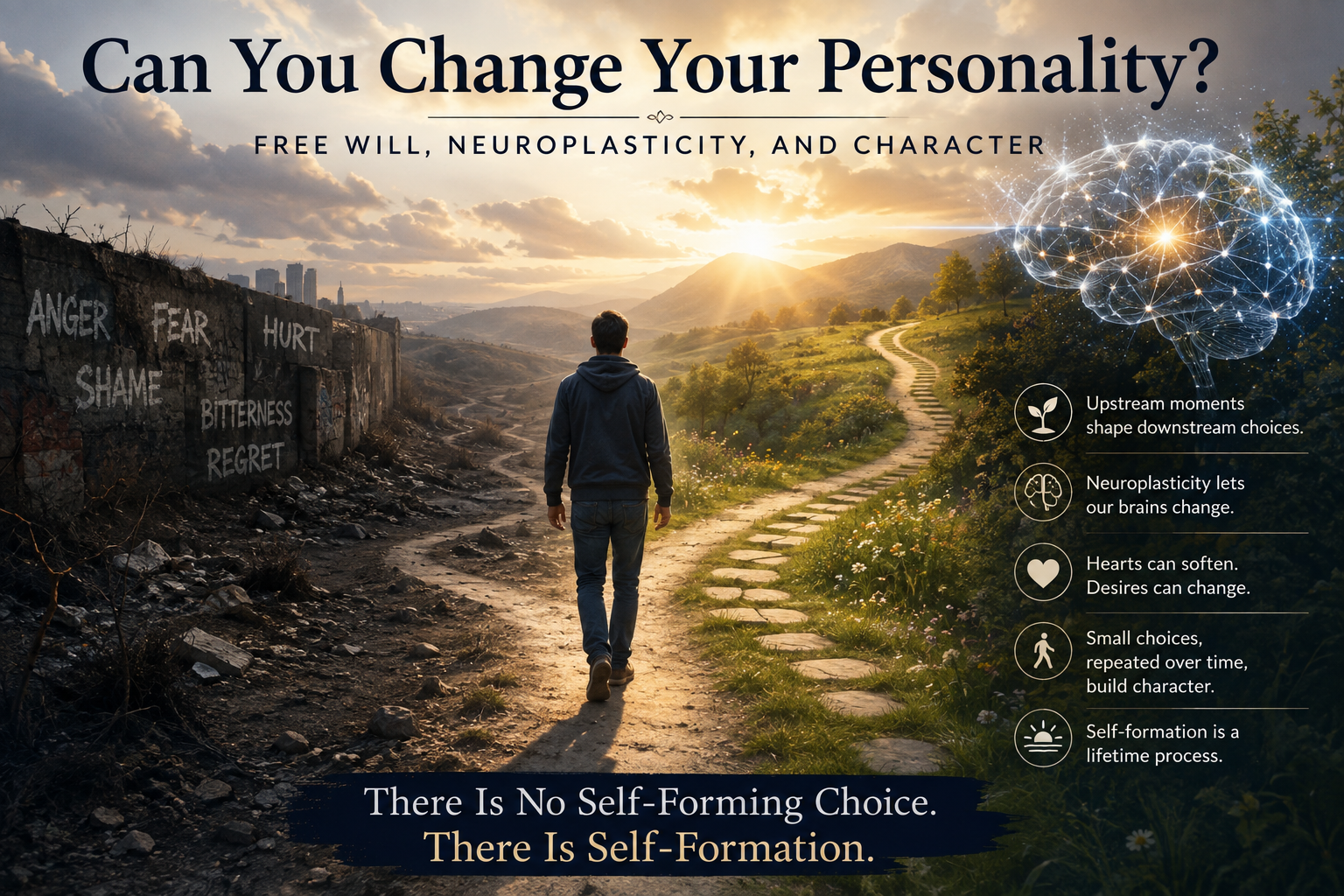
There Is No Self-Forming Choice
This also changes how I think about character.
Nobody wakes up one morning and decides:
“I am selfish. Today I will become generous.”
And then becomes generous.
Character develops gradually.
Experience affects us.
We respond.
Our response changes us slightly.
The changed person encounters the next experience.
He responds again.
Over years:
experience → response → change → new experience → new response → further change
The Bible sometimes describes this in terms of the condition of the heart.
A heart can harden.
A heart can soften.
A person can repeatedly dismiss his conscience until something that once disturbed him barely registers.
Another person can repeatedly contemplate the needs of others until compassion becomes increasingly natural.
There is no single decision that creates the person.
There is no self-forming choice. There is self-formation.
The Agent Doesn’t Create Himself
This is another place where Sapolsky and I substantially agree.
I didn’t choose my starting point.
I didn’t choose my genetics.
I didn’t choose my prenatal development.
I didn’t choose my childhood.
I didn’t choose countless events that affected the development of my brain.
I didn’t create myself.
But it doesn’t follow that I contributed absolutely nothing to what I became.
That’s the distinction I think gets lost when we move from much less freedom than we imagine to no freedom whatsoever.
Much of me happened to me.
But I believe some part of what I became also came from me.
Not because I created myself.
Because I was created with agency.
Where Does Agency Come From?
This is where my argument leaves neuroscience.
I believe genuine agency is a gift from God.
I don’t know the mechanism by which a conscious agent can originate a choice that wasn’t completely necessitated by the previous physical state of the universe.
I don’t pretend neuroscience has discovered one.
Perhaps it is ultimately beyond our ability to understand.
From my perspective, it is a miracle.
And this is why the title of this essay is not merely provocative.
If God does not exist, and physical reality is causally closed, I have difficulty seeing where genuine libertarian agency could enter the picture.
Randomness doesn’t solve it.
A random neural event isn’t free will.
Neuroplasticity doesn’t solve it.
Sapolsky can ask what caused the behavior that produced the plastic change.
Moving upstream doesn’t solve it.
Sapolsky can follow us there.
Eventually my disagreement with him rests on a fundamentally different understanding of what a human being is.
Sapolsky sees another link in the physical causal chain.
I believe there is also an agent.
God created agents.
The Cost of Zero
Why does this tiny disagreement matter so much?
Because zero changes everything.
If the contribution of the agent is zero, traditional moral responsibility becomes extraordinarily difficult to defend.
The murderer didn’t ultimately author his path toward becoming a murderer.
But neither did the hero author his path toward becoming courageous.
The forgiving person didn’t genuinely contribute to becoming forgiving.
The faithful spouse didn’t genuinely contribute to becoming faithful.
We can still protect society.
We can still discourage harmful behavior.
We can still encourage beneficial behavior.
But praise and blame mean something very different if nobody ever contributed anything genuinely originating from himself.
And I think the consequences reach even deeper.
They reach love.
If Love Is Determined, What Does Love Mean?
Imagine discovering that your spouse had been programmed from birth to love you.
She couldn’t reject you.
She couldn’t leave you.
She couldn’t choose anyone else.
Every embrace, sacrifice, affectionate word, and “I love you” was the inevitable output of that programming.
Would knowing that change what her love meant?
It would to me.
What makes love precious is not merely that someone loves us.
It is that the love is genuinely given.
Love has meaning because rejection is possible.
Faithfulness has meaning because betrayal is possible.
Courage has meaning because cowardice is possible.
Forgiveness has meaning because resentment is possible.
Goodness has moral significance because something else could have been chosen.
A determinist can still experience love, happiness, relationships, purpose, and meaning. I don’t deny that.
But I believe something important disappears when the contribution of the person himself becomes exactly zero.
Love becomes something that happened through him rather than something he also participated in giving.
Moral Responsibility Becomes Graded
Accepting the causal picture that Sapolsky describes also affects how I think about moral responsibility.
I don’t think everyone possesses equal freedom in every situation.
A person experiencing an overwhelming addiction may have far less room to maneuver than someone encountering that behavior for the first time.
A person in a violent rage may have far less effective freedom at that instant than during earlier moments when resentment was gradually being cultivated.
Genetics matter.
Childhood matters.
Trauma matters.
Neurological conditions matter.
Environment matters.
Habit matters.
Brain development matters.
That means moral responsibility cannot simply be:
You did it, therefore you were completely free, therefore you are completely responsible.
Responsibility may be graded.
It may extend across time.
We may be responsible not simply for a final downstream action but, to some degree, for the ways we genuinely participated in becoming the person who performed it.
And no human being can perfectly calculate that responsibility.
Only God Could Know
To judge another person’s moral responsibility perfectly, I would need to know everything.
His genetic starting point.
His prenatal development.
His childhood.
His neurological condition.
His environment.
His trauma.
His opportunities.
His habits.
The strength of the neural pressures operating upon him.
And every genuine opportunity he ever had to exercise agency differently.
I don’t know those things.
God would.
So my view of free will doesn’t lead me toward greater condemnation of people.
In fact, taking causation seriously pushes me in exactly the opposite direction.
Much more of what people become was done to them than we ordinarily acknowledge.
But I don’t believe the contribution from the person himself is always zero.
We are responsible to the extent that we genuinely participated in forming the character from which our actions emerged.
Sapolsky and I Travel Almost the Entire Road Together
There is an irony in all of this.
Of all the theories of free will I’ve encountered, the thinker I find myself closest to may be the man who says free will doesn’t exist.
Sapolsky and I can travel almost the entire causal chain together.
Genes?
Absolutely.
Prenatal development?
Yes.
Childhood?
Yes.
Culture?
Yes.
Hormones?
Yes.
Trauma?
Yes.
Environment?
Yes.
Brain states?
Yes.
Neural pathways?
Yes.
Everything that happened five minutes ago or twenty years ago?
Yes.
All of it matters.
All of it constrains us.
All of it helps explain why we do what we do.
Then we arrive at one final question.
After accounting for all of those causes, is the contribution of the conscious agent exactly zero?
Sapolsky says yes.
I say no.
I cannot scientifically prove that I am right.
I believe it because I believe God created conscious beings with genuine agency.
That agency may contribute only a tiny amount in any particular Upstream Moment.
But a tiny amount repeated thousands or millions of times can become part of the causal history influencing everything that follows.
That is the idea that originally led me to the Upstream Moment.
I wasn’t trying to escape the causal stream.
I was trying to understand how a genuinely free agent could participate in it.
Perhaps the answer is that agency doesn’t need to be enormous.
Perhaps most of the causal story really is exactly what Sapolsky says it is.
Our genes.
Our brains.
Our childhoods.
Our environments.
Our experiences.
Our histories.
All bearing down on the present moment.
I grant him all of that.
I disagree only when much less becomes none.
Because almost zero is not zero.
And if something genuinely comes from the agent—even something minuscule—then a human life is no longer exclusively the story of things happening to a person.
The person participates.
A little at a time.
Moment after moment.
Upstream.
And over a lifetime, that little bit can make all the difference.
Discussion on the nature of free will ->
Robert Sapolsky’s book Determined ->