Free Will = Anti-Entropy: How Agency Creates Order
Look around your house.
Don’t clean anything.
Don’t repair anything.
Don’t organize anything.
Don’t mow the lawn. Don’t wash the dishes. Don’t replace the broken hinge. Don’t put the books back on the shelf.
Just wait.
What happens?
Things tend to deteriorate.
Maintaining order requires work.
There is something in physics that seems, at first glance, to capture this tendency: entropy.
And that raises an intriguing question.
What if free will is, in a meaningful sense, anti-entropy?
I don’t mean that free will violates the second law of thermodynamics.
It doesn’t.
I mean something more subtle.
Conscious agents can imagine states of organization that do not yet exist and deliberately direct energy and matter toward creating them.
And perhaps most remarkably, we can sometimes direct that organizing process toward ourselves.
What Entropy Actually Means
Entropy is often described simply as a measure of “disorder.”
That’s useful as an illustration, but the actual physics is more precise.
In thermodynamics, entropy is a measurable property related to the number of microscopic configurations available to a system and to the dispersal of energy. The second law tells us that the total entropy of an isolated system does not spontaneously decrease.
But that does not mean everything everywhere must continually become more disordered.
Local entropy can decrease.
It happens constantly.
A refrigerator maintains a colder, lower-entropy region inside itself by consuming energy and releasing heat into its surroundings.
Plants use energy from sunlight to build highly organized structures.
Our bodies use chemical energy from food to maintain an astonishing degree of biological organization.
None of this violates the second law because these are open systems exchanging energy with their surroundings. Maintaining local organization comes at an energetic cost, and total entropy still increases.
So free will isn’t required to decrease entropy locally.
Nature does that perfectly well without it.
But conscious agents appear capable of doing something additional.
They can create intentional order.
The Difference Is Intention
Imagine an empty piece of land.
There are piles of lumber, steel, glass, wire, concrete, and other materials scattered around it.
Six months later, a house stands there.
The electrical wiring follows a plan.
Water flows through pipes.
Windows have been positioned to admit light.
Walls divide the space into rooms.
A kitchen exists where no kitchen existed before.
Nothing about this violates thermodynamics.
Energy was consumed. Machines operated. People ate food and burned fuel. Heat was released into the environment. Total entropy increased.
But something remarkable happened at another level.
Before the house physically existed, something resembling it existed in someone’s mind.
Someone imagined a possible future.
Then conscious beings made choices that directed physical processes toward that future.
The house is therefore not merely organized.
It is intentionally organized.
That distinction is important.
A snowflake can form an extraordinarily ordered structure without imagining anything.
A plant can construct a leaf without deciding what shape the leaf should take.
A crystal can form an intricate lattice without possessing a goal.
But a conscious agent can look at what exists and imagine what could exist.
Then the agent can act to narrow the distance between the two.
That is the sense in which I call free will anti-entropic.
Not because it reverses the second law of thermodynamics.
Because agency can deliberately create and maintain local organization.
We Do This Constantly
Look around you and much of what you see exists because conscious beings imposed intentional organization on matter.
Buildings.
Roads.
Computers.
Books.
Gardens.
Paintings.
Cities.
A pile of silicon, copper, glass and plastic doesn’t spontaneously organize itself into a laptop.
Energy and matter have to be directed toward a particular configuration.
And behind that configuration was information.
A plan.
An intention.
A desired future state.
Humans don’t merely react to the world as it currently exists.
We represent possibilities that do not yet exist.
Then we can work toward making one of those possibilities real.
But this becomes much more interesting when the thing being organized isn’t a house or computer.
It is ourselves.
The Brain Can Change
The human brain is not a static structure.
It changes in response to experience, learning, behavior, environment, and repeated use.
This capacity is called neuroplasticity.
Learning can alter synaptic connections. Experience can produce structural and functional changes in neural systems. Activities repeatedly practiced can become progressively more familiar and automatic.
That doesn’t mean we can simply decide to “rewire our brains” however we want.
Biology places real constraints on us.
Genetics matters.
Childhood matters.
Environment matters.
Trauma matters.
Existing habits matter.
Our previous experiences matter.
But the brain we have today is not necessarily identical, functionally or structurally, to the brain we will have years from now.
Experience helps shape it.
And some of our experiences result from things we deliberately choose to do.
That’s where the Upstream Moment becomes important.
The Upstream Moment
We tend to think free will occurs during dramatic decisions.
The recovering addict experiences an overwhelming craving.
The angry person is insulted.
The married person encounters an opportunity to be unfaithful.
Two possibilities appear.
Choose A or choose B.
That is where we imagine free will doing its work.
I think we may be looking too far downstream.
By the time a powerful temptation arrives, years of previous experience may have strengthened some patterns of thought and behavior far more than others.
The crisis may actually be one of the moments when our effective freedom is most constrained.
The more interesting moments may have happened much earlier.
Quiet moments.
A thought appears.
Do I entertain it?
Do I redirect my attention?
Do I replay the resentment?
Do I consider the other person’s perspective?
Do I indulge the fantasy?
Do I dismiss it?
Do I pray about it?
Do I rationalize what I’m considering?
Do I stop and think?
One moment changes very little.
But there can be millions of them.
I call these upstream moments.
Creating Order Within Ourselves
Imagine a man with a terrible temper.
Perhaps he was born with an impulsive temperament.
Perhaps anger was modeled throughout his childhood.
Perhaps years of repeatedly responding aggressively have made that response increasingly habitual.
He didn’t choose all of that.
That is the person standing at the beginning of our example.
Then something begins to change.
One day he becomes angry and, afterward, thinks about what happened.
The next time resentment appears, he recognizes it.
He deliberately considers the other person’s perspective.
Another time, he catches himself rehearsing an argument in his head and redirects his attention.
Perhaps he prays about his anger.
Perhaps he apologizes after losing his temper.
Perhaps he begins practicing patience deliberately.
None of these things turns an angry man into a patient man.
But then he does them again.
And again.
And again.
His experiences are changing.
His behavior is changing.
His patterns of attention are changing.
And because the brain is plastic, repeated experience can contribute to changes in the neural systems underlying future behavior.
Eventually something interesting can happen.
What once required tremendous effort may require less.
The man isn’t merely acting patient.
Patience is becoming part of his character.
Free Will as Intentional Anti-Entropy
This is where the entropy analogy becomes most interesting to me.
The man didn’t create himself.
He didn’t choose his starting brain.
He didn’t choose his genetics.
He didn’t choose many of the experiences that formed him.
He inherited a system that already had structure.
Some of that structure may have been beneficial.
Some may have been destructive.
But if genuine agency exists, he isn’t merely trapped inside that structure.
He can participate in changing it.
Not instantly.
Not without limits.
Not by simply wishing to be different.
But incrementally.
Through repeated choices, he can participate in creating new patterns of behavior.
And those new experiences can participate in reshaping the physical brain through neuroplasticity.
The process looks something like this:
agency → choice → repeated behavior → experience-dependent plasticity → altered tendencies → character
Then the cycle continues.
The changed person encounters the next upstream moment slightly differently.
A small change influences the next choice.
That choice contributes to another change.
Over years, tiny differences accumulate.
This is what I mean when I say:
Free will is anti-entropy.
I don’t mean that free will is a mysterious thermodynamic force.
I mean that genuine agency allows a conscious being to participate intentionally in creating organized patterns that otherwise might not have existed.
Including patterns within himself.
There Is No Self-Forming Choice
This also changes how I think about character.
We sometimes imagine personality change as a dramatic decision.
One day a selfish person decides to become generous.
An angry person decides to become peaceful.
An addict decides to stop being an addict.
But human beings rarely change that way.
Character develops gradually.
The Bible describes a process of “putting on the new personality.”
I think that’s an extraordinarily appropriate description.
You don’t create a new personality with one decision.
You build it.
One thought.
One response.
One act.
One correction.
One failure.
One reconsideration.
One better choice.
Repeated over years.
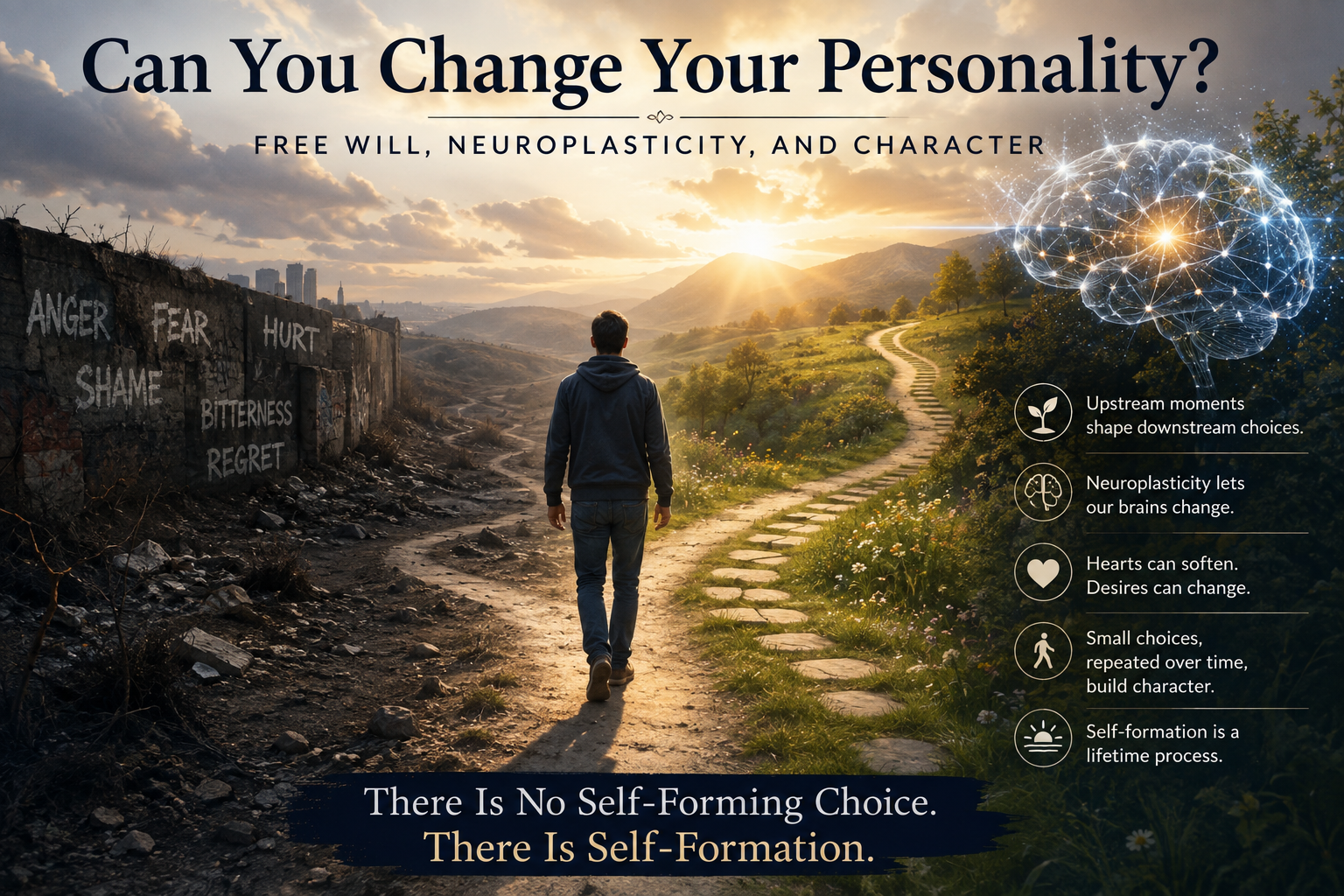
There is no self-forming choice. There is self-formation.
Order Is Not Necessarily Good
There is another important qualification.
Order itself isn’t morally good.
A dictatorship can be extremely organized.
A criminal organization can be organized.
Someone can deliberately cultivate resentment, deception, or cruelty just as someone else can cultivate compassion.
The brain doesn’t ask whether the patterns being reinforced are morally admirable.
Repeated experience can strengthen destructive patterns too.
So free will isn’t necessarily a machine for producing goodness.
It is a capacity for directing ourselves toward possibilities.
We can create constructive order.
And we can create destructive order.
We can use agency to increase our future freedom.
Or we can repeatedly make choices that eventually constrain it.
An addiction illustrates this particularly well.
Early choices can become repeated behavior.
Repeated behavior can become habit.
Habit can become compulsion.
What began as something relatively easy to refuse can become extraordinarily difficult to resist.
In that sense, freedom can be used to create future constraints.
But the reverse may also be possible.
Small upstream choices can gradually weaken an established behavioral pattern while strengthening another.
Freedom can participate in creating greater future freedom.
Does Neuroplasticity Prove Free Will?
No.
This distinction is essential.
Everything I’ve said about neuroplasticity could be accepted by someone who believes free will doesn’t exist.
A determinist can say:
“Of course experience changes the brain. But what caused you to choose those experiences?”
That’s a legitimate question.
Neuroscience can demonstrate that brains change.
It cannot currently demonstrate that a conscious agent originated a choice independently of a completely sufficient chain of prior physical causes.
So the science ends there.
My argument takes another step.
I believe genuine agency exists.
I believe a conscious person can sometimes consider reasons, possibilities, desires, and consequences and originate a choice that was influenced by—but not completely determined by—everything that came before it.
I cannot prove that with thermodynamics.
I cannot prove it with neuroplasticity.
And I don’t want to pretend that I can.
My belief ultimately rests on something beyond those sciences.
I believe God created agents.
Agency Is the Missing Ingredient
If genuine agency exists, something extraordinary enters the picture.
A conscious being can encounter the world as it is, imagine the world as it could be, and choose to work toward one possibility rather than another.
We do this externally.
We build houses.
We write books.
We plant gardens.
We repair things.
We make plans.
We transform available matter and energy into structures corresponding to ideas that previously existed only in consciousness.
But we can also turn that capacity inward.
I can consider the person I am.
I can imagine the person I want to become.
The distance between those two people may be enormous.
I cannot simply choose to eliminate that distance.
But perhaps I can choose the next step.
And later another.
And another.
Those steps become experiences.
Experiences change brains.
Changed brains affect future behavior.
And over a lifetime, character emerges.
Free Will = Anti-Entropy
So is free will literally anti-entropy?
No.
Not in the thermodynamic sense.
Free will does not reverse the second law.
It doesn’t need to.
Every thought we have and every action we perform occurs within a physical organism consuming energy and producing entropy.
The laws of thermodynamics remain intact.
I am using anti-entropy in a different, deliberately metaphorical sense.
Free will is anti-entropic because agency can be directed toward intentional organization.
It can take what exists and work toward what does not yet exist.
A clean room.
A bridge.
A garden.
A book.
A repaired relationship.
A disciplined mind.
A compassionate heart.
A different character.
Physics describes the energetic cost of these transformations.
Neuroscience can increasingly describe how experience changes the brain.
Neither, by itself, answers the philosophical question of whether a conscious agent genuinely chose among possible futures.
That is where my theory begins.
I believe we are more than systems being carried helplessly from one physical state to the next.
We are agents.
We don’t choose our starting conditions.
We don’t control everything that happens to us.
And we cannot simply command ourselves to become whatever we wish.
But within those constraints, I believe God has given us something remarkable.
The ability to participate in what happens next.
I didn’t create the person.
I participate in creating the character.
And in that sense, free will really is anti-entropy.
Click here for a discussion on what entropy is>>